Downloadliste
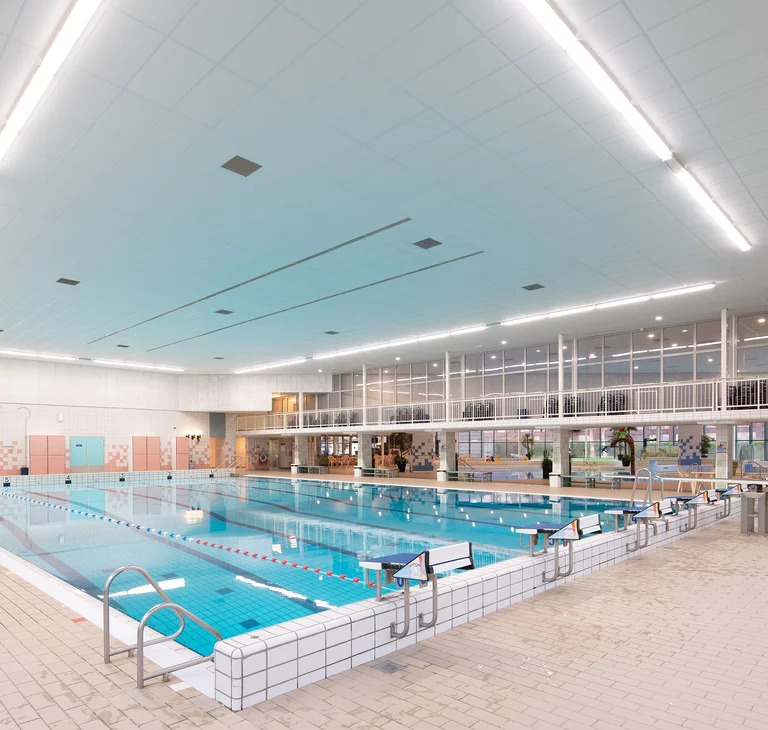
Save energy and costs in swimming pools in the long term
Ventilating indoor swimming pools is challenging, as a wide variety of requirements must be met under the ‘swimming cap’. While bathers want comfort without stuffiness, swimming pool operators have other goals: the building structure must be protected from condensation, and at the same time, the ventilation technology should keep operating costs low through efficient energy use. Expertise is required to achieve this triple challenge.
The evaporation of water is the reason why swimming pool ventilation always requires dehumidification of the indoor air. The driving force behind evaporation is the temperature-dependent pressure difference between the layer of air adjacent to the water and the air in the swimming pool hall. Its effects on the indoor air increase with the size of the water surface and with the movement of the pool water.
Many swimmers and attractions (e.g. wave machines or floor jets) promote evaporation and the resulting mass flow of water from the pool water into the room air.
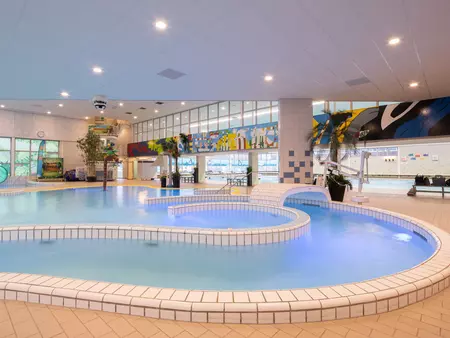
Usage-dependent pool and room temperatures
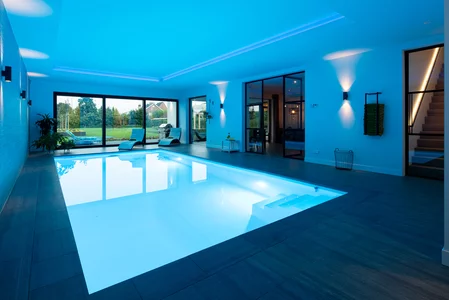
VDI 2089 Sheet 1 recommends that the room air temperatures in the pool area should be 2 K to 4 K above the pool water temperature during operating hours. However, a room air temperature of 34 °C should not be exceeded. This ensures that the evaporative cooling (heat extraction) on damp or drying skin is still perceived as pleasant. The pool water temperature, in turn, is determined according to the use of the pool. For example, a pool used for swimming usually has a temperature of 28 °C, while a therapy pool can be heated to up to 36 °C.
Humidity limit
The humidity limit results from the planned activity of visitors in the swimming pool in the air temperature range of 30 to 34 °C: While dry, slightly active people find absolute humidity below 10 g/kg comfortable, unclothed people who are wet with water only consider the air to be humid when the absolute humidity is between 21 g/kg and 30 g/kg of dry air, depending on the room temperature.
Dew point
In addition to visitors' perception of humidity, special attention must be paid to building physics. To prevent mould growth in the damp condensate environment, the dew point must not be undershot either in terms of time or location. Wooden and steel structures should also not be exposed to air humidity levels outside the tolerance range of 40–64% relative room humidity.
To protect the building, VDI 2089 Sheet 1 recommends a limit value between 14.3 and 17.2 g/kg for the water content, depending on the insulation standard.
However, a building physicist must be consulted for the final assessment and determination.
Water mass flow
Only optimal thermal insulation would prevent the formation of condensation on the inside of the swimming pool building envelope at an absolute water content of 17.2 g/kg. In order to determine the limit value for the water content of the indoor swimming pool air, the evaporating water mass flow is calculated precisely for each type of pool separately, as the VDI 2089 Sheet 1 guideline lists factors based on empirical values for each attraction individually.
The evaporating water mass flow is calculated as follows in accordance with VDI 2089 Sheet 1

▪ 𝛽𝑢/𝑏 Water transfer coefficient for (un)used basin, m/h
▪ 𝑅𝐷 Specific gas constant for water vapour, 𝑅𝐷 = 461,52 J/(kgK)
▪ 𝑇 arithmetic mean of water and air temperature, K
▪ 𝑝𝐷,𝑊 Saturation vapour pressure at a given water temperature, Pa
▪ 𝑝𝐷,𝐿 Water vapour partial pressure in the indoor swimming pool air,Pa
▪ 𝐴𝐵 Reference area, m2 (nominal dimensions of the pool or usable water area)
This formula shows that the water surface area and the difference between the saturation pressure of the pool water and the partial pressure of the water vapour in the ambient air are the key factors determining the energy costs of a swimming pool.
It must also be considered that water evaporation is not the same everywhere, as it depends on the movement of water caused by bathers and the number of different attractions (such as a water mushroom in the non-swimmer area, etc.).
Dehumidification range
Based on the maximum evaporating water mass flow calculated in this way during the opening time, the required outside air mass flow or the air volume flow of the outside air to be supplied can be roughly calculated. In accordance with VDI 2089 Sheet 1, a dehumidification range of 5.3 g/kg has proven effective in practice.
MA,s Outdoor air design mass flow rate, kg/h
MD,O,max Maximum evaporating water mass flow during opening hours
Δ𝑥=5,3 𝑔/𝑘𝑔 Dehumidification range (water content difference)
The dehumidification range is shown in the h,x diagram.
Demand-based operation
From an energy perspective, it almost goes without saying that the air exchange rate must be adjusted to the respective operation in the hall according to demand. Adequate and representative sensor technology for measuring humidity is therefore necessary in order to be able to ventilate appropriately – Even if the room humidity appears adequate from a building physics point of view, decomposition products from disinfectants or bath additives in therapy and saltwater pools must be removed from the indoor swimming pool air in order to minimise the typical ‘swimming pool smell’.
In addition to the comfort limits caused by the moisture content in the air, low air velocity also contributes to well-being, so the air distribution in the room must be planned very carefully for this purpose.
Low air velocities in the unit are associated with lower resistance, thus minimising the electricity costs for air transport. Optimum air velocities also enable efficient heat transfer in the heat exchanger.
Outside operating hours, the supply of fresh air can be reduced to as little as 10% under certain circumstances.
Variables for swimming pool dehumidification
In order to design a ventilation unit for indoor swimming pool dehumidification that is precisely tailored to the requirements, various variables must be taken into account:
- The temperature- and usage-dependent evaporating water mass flow
- The reference area(s) and pool depth(s)
- Possible attractions such as wave machines, neck showers, slides, etc.
- The corrosive potential of the evaporating pool water
- The comfort of visitors (temperature, humidity and odours)
- Hygiene requirements
- The most efficient use of energy during pool operation, closing times and cleaning
- The building physics (e.g. energy standard, building geometry and volume, building materials)
- The durability and efficiency of the ventilation unit
- Air distribution and extraction in the hall
- The Life Cycle Costs
Well thought-out and customised device design
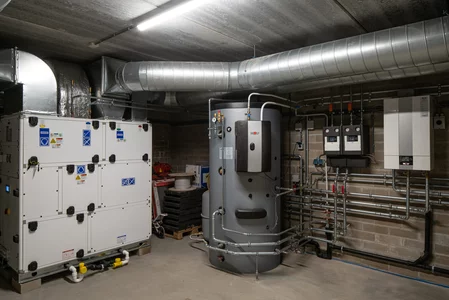
Not only the air flow in the hall, but also the device design in particular offer significant potential for savings over the service life of a device. A well-planned ventilation system can significantly reduce operating costs – and thus life cycle costs – making investment in high-quality ventilation technology, which may appear expensive at first glance, very economical over the service life of the unit. Ventilation units for indoor swimming pools should have the following features:
- Efficient heat recovery in the recuperator without moisture transfer achieves high heat recovery rates – the best values are achieved with coated aluminium heat exchangers.
- Good thermal properties of the housing minimise heat loss.
- Efficient, continuously variable EC fan technology reduces power consumption.
- Intelligent control and the option of precisely demand-based operation further reduce energy costs.
- Comprehensive corrosion protection (stainless steel and, for example, powder-coated or plastic-coated surfaces) in the housing construction, the built-in and attached components, the frame and the fastening elements guarantees a long service life.
- Smooth surfaces that are easy to access and clean are not only very hygienic but also minimise the risk of corrosion from corrosive components in the form of aerosols in the indoor swimming pool air.
- An integrated heat pump contributes to energy efficiency (additional heat recovery). To simplify installation, the refrigeration circuit should be combined in one component if possible and supplied by the manufacturer as a ‘finished’ component.
- A pool water condenser (optional with a heat pump) offers the possibility of transferring exhaust air heat to the pool water (if the demand on the air side is already covered).
- The ability to install a unit indoors or outdoors increases flexibility in planning.
- Individually customisable air handling units in terms of dimensions and functionality (components) expand the scope for action.
- Modern interfaces such as MODBUS, BACNet, BACNet/IP, LON and IC Cloud Access System for building management technology offer a solution for every requirement and enable operation and monitoring via a web browser.
Air volume flow calculation with the VDI Pool web app:
To simplify planning, WOLF has developed its own calculator for swimming pool ventilation units. By quickly and easily entering parameters, the WOLF VDI Pool web app calculates the required air volume for the entire pool area (as the sum of the various pools and facilities/attractions). The app is based on the guidelines of VDI 2089 Sheet 1 and its tried-and-tested standards and calculates using stored product data for WOLF pool air handling units. Step 1: Enter basic data on the water surface, water depth, water temperature, air temperature and relative humidity. If available: Select possible attractions, if necessary, a channel with additional attractions with its parameters, and specify the air volume and minimum air exchange. Step 2: The WOLF VDI Pool web app calculates the water mass flow from the data entered and derives the water transfer coefficient. This in turn is used to calculate the minimum supply air mass flow and the minimum supply air volume flow. The result complies with the recommendations of the VDI guidelines: it serves as a recommendation for the air volume and a resulting device size with its technical data, matching LV texts, an h,x diagram and CAD files. This package serves as the basis for further detailed planning.
The WOLF VDI Pool Web App can be found at: https://wolf.ahuapps.eu/
Autor: Further information on WOLF air handling units can be found at: https://www.wolf.eu/en-de/professional/ahu-products
|