Downloadliste
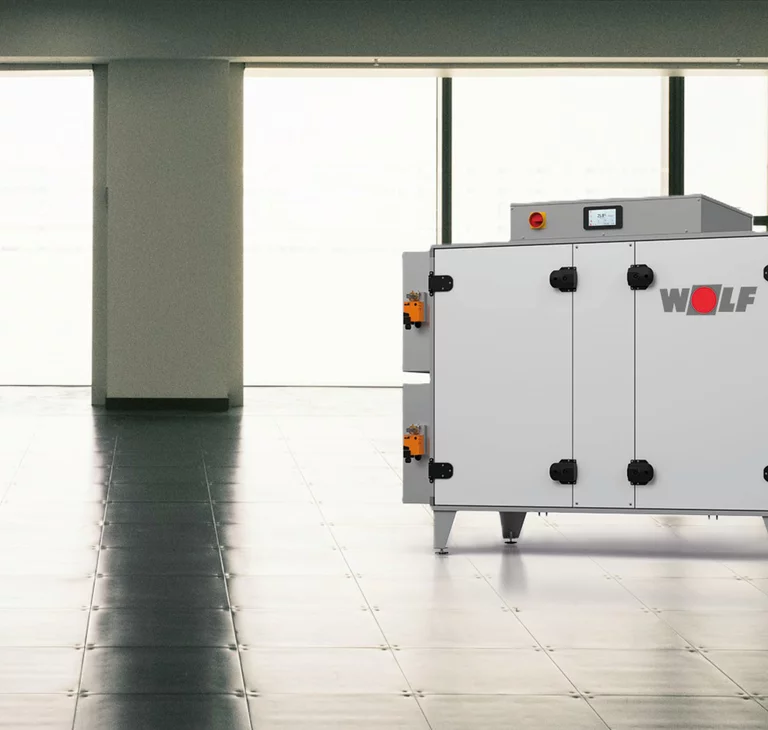
When installation space is scarce: CRL evo
WOLF expands its CRL evo range with new unit sizes and comfort features
When determining where a central air handling unit can be installed, smaller buildings or individual building areas often pose the same challenge: only very limited technical space is available. At the same time, these frequently occupied spaces have indoor air requirements comparable to those of large buildings. Peter Hofstetter, Campus WOLF, Mainburg, explains why compact central air handling units with rotary heat exchangers are the ideal solution for combining comfort with efficiency.

1. Medical practices, childcare facilities, nursing homes and, of course, small to medium-sized office buildings – what requirements do these types of non-residential buildings have?
Peter Hofstetter:
All these types of buildings have one thing in common: a large number of people come together in them. Naturally, no one wants to be exposed to airborne pathogens. At the same time, these buildings require a demand-controlled, energy‑efficient and draught-free supply of fresh air, as well as the extraction of “used” air enriched with CO₂. Limited installation space in technical rooms is not a knockout criterion for efficient ventilation technology – compact units with rotary heat exchangers can be used here, both in new-builds and refurbishment projects.
2. Why use rotary heat exchangers, and what are their distinguishing features?
Peter Hofstetter:
Heat exchangers are generally used to transfer heat contained in the extract air to the fresh supply air. In doing so, more than 80 percent of the thermal energy is recovered, meaning it does not need to be generated again by the heating system. This offers substantial savings in operating costs and ensures compliance with the requirements of the German Buildings Energy Act (GEG). On warm or hot days, rotary heat exchangers also prevent rapid heating of indoor spaces due to incoming warm outdoor air.
Rotary heat exchangers also have a positive impact on indoor humidity. In the sorption rotor version, the moisture contained in the extract air humidifies the cold, dry outdoor air in winter, creating a pleasant indoor climate. In summer, the effect is reversed: the typically more humid outdoor air is dehumidified.
3. What are the advantages of choosing a compact air handling unit?
Peter Hofstetter:
The Eurovent-certified CRL evo series offers finely graded unit sizes from 1,300 to 4,900 m³/h, meaning the right unit is available for every requirement. Investors therefore do not need to accept technical compromises regarding air volume – they can select the exact size that fits their project. Another advantage of these fully wired, plug‑and‑play-ready units is the very low installation effort. They require only a few interfaces with other trades, which is particularly beneficial in retrofit applications. At the same time, the intelligent control system allows demand-controlled high outdoor air volume flows – very quietly and, thanks to appropriate filtration, with high hygiene standards.
Planning and installation work is also reduced. For easy transport into buildings, CRL evo units intended for indoor installation are divisible from 4,200 m³/h upwards. In the same performance range, weatherproof outdoor versions are available in identical gradation.
4. What new features does the CRL evo offer?
Peter Hofstetter:
We provide the right rotary heat exchanger for every application. In the range from 1,300 to 4,900 m³/h, a modular system of six variants per unit size is available. This includes three rotor types (condensation rotor, enthalpy rotor and sorption rotor) with different sealing variants. This allows very specific humidity management solutions for all unit sizes – both for indoor and outdoor installation.
The active conditioning of the supply air is also individually configurable, with options including water-based cooling and heating coils or integrable electric heating modules.
For outdoor installations, the climate split version of the CRL evo is optionally available as a compact solution mounted on a shared base frame.
The CRL evo can also be extended with additional external modules – for example for filtration or air conditioning – to enhance the performance capabilities of each unit size. These modules are simply connected to the base unit.
As the market continues to focus more strongly on Green Air Handling, WOLF offers all units in an optional Green Steel version, significantly reducing the CO₂ footprint of manufacturing. Efficiency is further enhanced by the use of labyrinth seals and a full-featured control system that enables comprehensive energy monitoring.
More information about WOLF CRL evo is available at: https://www.wolf.eu/en-de/professional/ahu-products/compact-units/crl-evo