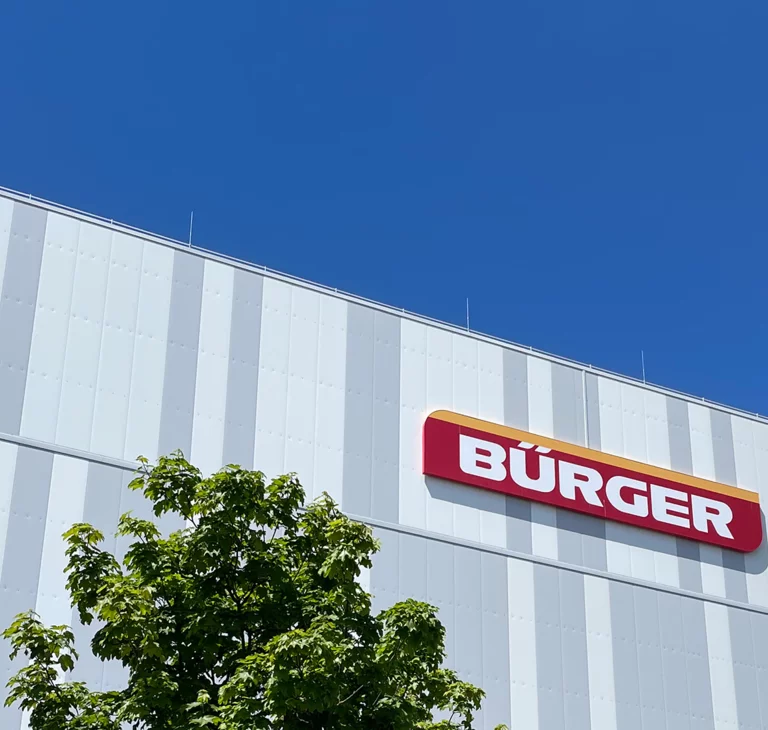
Plus cooling without draughts - Traditional company Bürger takes a new path in Crailsheim
In an innovative and sustainable concept for its new logistics centre, Bürger, the national market leader in chilled dough products, combines the highest standards of energy efficiency with maximum comfort for employees. Instead of installing brine–air coolers in the positive-temperature area, particularly in order picking, WOLF air handling units ensure uniform distribution of positive cooling throughout the space — completely without any draughts.
To reliably meet the steadily increasing demand for Swabian specialities, the family‑owned company Bürger has invested in a highly automated logistics centre and a new, sustainable refrigeration plant at its Crailsheim site. The new facility has tripled the previous storage and loading capacities compared to the decentralised legacy solutions that have now been dismantled.
The increased storage areas compensate for seasonal production peaks, while also providing reserves for the planned expansion of production areas. Bürger continues to be on a clear growth trajectory. Around 60 percent of its products are sold as fresh goods through food retailers, 30 percent are delivered frozen to large‑scale consumers (e.g. restaurants, student unions, canteens), and the remainder is produced for industrial customers.
Storing 295 tonnes of dough products per day
The logistics centre, commissioned in 2024 for all outbound goods, covers a total footprint of 12,000 m². Both the chilled and deep‑freeze high‑bay storage areas reach a height of 34 metres. Each working day, around 295 tonnes of packaged dough products are automatically stored and dispatched — including approximately 2.9 million ‘Maultaschen’.
Via conveyor belts, the freshly produced, packaged, chilled or shock‑frozen and palletised products are transferred from production to the logistics centre. This process is visible from the street, as the pallets move through a climate‑controlled glass bridge that crosses the road between Production Plant 1 and the logistics centre.
The deep‑freeze high‑bay warehouse (-24 °C) offers 11,200 pallet spaces, while the positive‑temperature refrigerated area (+4 °C) provides 4,800 pallet spaces. These enclosed storage rooms are designed to be personnel‑free and are inertised for fire protection (reduced oxygen concentration through controlled nitrogen injection). Approximately 5,500 m² are available for order picking, staging and packaging. A fully automated layer palletiser is used for deep‑freeze products. Above the loading zone in the picking area, there is also an administration wing covering 1,100 m² including sanitary facilities.
Objective: optimal working conditions
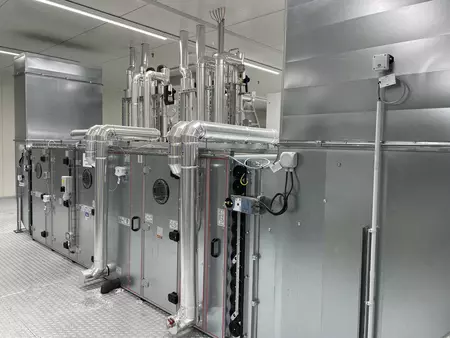
Not only the administration area but also the circulation and picking zones are air‑conditioned using WOLF KG Top units. Combined, they provide an air volume flow of 203,800 m³/h.
“Our goal was to provide our employees with the best possible working conditions. Draughts are a considerable factor at workplaces in deep‑freeze and positive‑temperature areas — they affect comfort and can have negative health impacts,” says project manager Steffen Gaab, Head of Facility Management at Bürger.
In addition, filtration of outdoor and indoor air creates further value for staff in the logistics halls: dust generated from cardboard packaging is continuously extracted from the space.
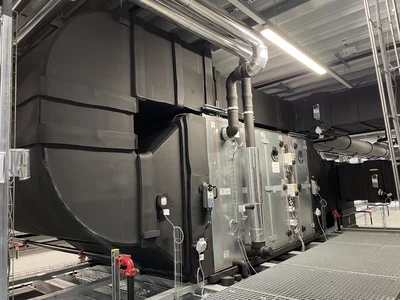
The temperature in the picking areas is constantly maintained at +4 °C to ensure an uninterrupted cold chain. Ten WOLF KG Top recirculation units without heat recovery were installed for this area. The AHUs are located on a segmented technical level above the conditioned rooms, which also houses the sprinkler system. Each unit block consists of a supply and extract air section, with a second unit connected in parallel operating exclusively in recirculation mode. The two units are connected via louvre dampers to ensure cooling across the entire area. During defrosting or maintenance, the dampers open and the airflow of the second system increases automatically.
Proper insulation required
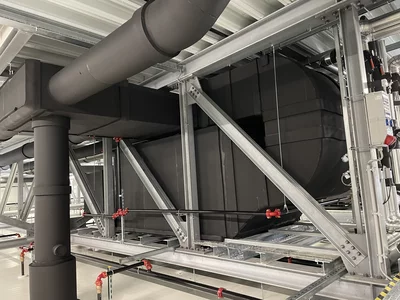
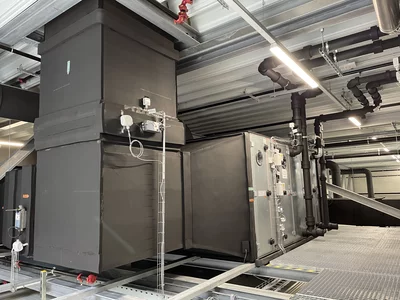
“One special requirement for the installation on the technical level was that the surfaces of air‑handling components would be colder than the ambient air if they were not insulated externally in addition to the internal insulation,” explains Steffen Gaab. “Without this insulation, the dew point of the ambient air would regularly be undershot, particularly during humid summer conditions, resulting in significant condensation. Therefore, the WOLF AHUs and all associated pipework were encased with 25 mm elastomer insulation.”
Special attention also had to be given to the intermediate ceiling separating the deep‑freeze rooms from the technical level above. Despite insulation, this ceiling would gradually reach temperatures only slightly above the freezing point. Without countermeasures, this would cause substantial cooling of the technical level. To prevent this, WOLF LH‑EC40 air heaters raise the temperature above this zone to at least 10 °C when required, preventing the sprinkler system from freezing.
Avoiding draughts
Conditioned air is distributed evenly through ductwork and ceiling‑mounted swirl diffusers arranged in a grid. The supply air enters the space with a swirling motion. This swirl impulse creates strong induction, meaning the supply air quickly and effectively mixes with the room air. This effect, combined with low discharge velocities, prevents draughts and ensures uniform temperature distribution. The warmer return air is removed near the AHUs through a large ceiling opening.
In normal operation, the units run at an airflow rate of 15,000 m³/h and cool the warehouse down to +4 °C (or operate with mixed air during very cold outdoor temperatures). Air velocities in the 4.5‑ to 8.5‑metre‑high rooms remain below 2 m/s, ensuring draught‑free conditions. Supply air temperature is 1 °C, and extract air temperature is approximately 4 °C. The cooling source is centrally supplied chilled brine (-10 °C / -2 °C). When outdoor temperatures drop below +3 °C, outdoor air is used; if the temperature drops further, the supply air temperature is regulated by mixing return and outdoor air. This ensures high efficiency, reduced energy consumption and improved comfort.
Environmentally friendly refrigerant: ammonia
The new three‑stage ammonia refrigeration plant is one of the most modern in Europe. Installed on a ground‑floor area of 1,400 m², it uses a combination of 23 high‑efficiency screw and piston compressors delivering a total cooling capacity of 12 MW, along with a water management system and heat recovery.
Because sustainable business practices form part of Bürger’s corporate principles, the company opted for the natural and environmentally friendly primary refrigerant ammonia.
Depending on the application, the refrigerant flow temperature is -10 °C (chilled brine, e.g. for fresh‑goods storage), -25 °C (ammonia, e.g. for production line freezers), or -35 °C (ammonia, e.g. for deep‑freeze storage).
Four plate heat exchangers cool the brine to -10 °C, which is then distributed throughout the logistics centre and part of the existing production facility. Only around 18 percent of the cooling produced is used in the logistics centre; the majority is required for the production lines (e.g. process coolers and freezers).
Using waste heat for heating and district heating
The refrigeration system offers two sources of usable waste heat. Waste heat from compressor oil cooling at 45/55 °C is used to heat the warm brine, which in turn supplies heating (e.g. underfloor heating in office areas), domestic hot water for sanitary rooms, and defrosting of AHU cooling coils. As a result, the logistics centre requires no separate heat generator.
The second waste‑heat source is condenser heat. Through an additional heat exchanger, the gaseous refrigerant is cooled by 20–25 K. This improves the efficiency of the adiabatic condensers, and the extracted heat is used beneficially: in cooperation with the Crailsheim municipal utilities, it is fed through district heating lines to the local pool complex (outdoor pool, indoor pool, ParkVital). The compressors generate sufficient recoverable heat to cover around two‑thirds of the complex’s heat demand.
Hydraulic circuit for efficient part‑load operation
Using appropriate on‑site sensor technology, the speed of the primary pump is adjusted when the pressure‑independent two‑way valve closes during part‑load operation.
The two‑way valve not only compensates for pressure fluctuations but also ensures optimal and demand‑oriented flow of the heating/cooling medium through the heating or cooling coil. Heat transfer from the water circuit to the supply air is particularly uniform and efficient.
During part‑load operation of the AHU, the flow rate — and thus the power consumption of the speed‑controlled primary pump — is significantly reduced. Thermal losses are also lower than with a traditional bypass solution combined with a generator pump running constantly at nominal duty.
Using a pressure‑independent valve in the integrated hydraulic circuit eliminates the need for hydraulic balancing, ensuring quick and simple integration into the building’s pipework. System design was also substantially simpler than designing a solution with a three‑way valve.
Sustainable operation with solar power
During construction, care was taken to exceed legal building-envelope insulation requirements. This foresight has already proved worthwhile, as compressor energy consumption is significantly lower than initially calculated. All technically suitable roofs on the Bürger premises in Crailsheim are equipped with PV modules generating electricity exclusively for on‑site use. In total, 3,078 kWp of PV capacity is installed, saving approximately 1,500 tonnes of CO₂ per year. The PV system on the logistics centre alone, rated at 687 kWp, saves around 342 tonnes of CO₂ annually.
This form of energy generation has proven especially beneficial during the summer months, when cooling demand is at its highest. “The logistics centre and its connected refrigeration plant were designed for sustainable operation and bring us closer to our overarching goal — the complete decarbonisation of our production,” says Steffen Gaab.
More information about WOLF ventilation technology is available at: https://www.wolf.eu/en-de/professional/ahu-products